Why do I Paint?
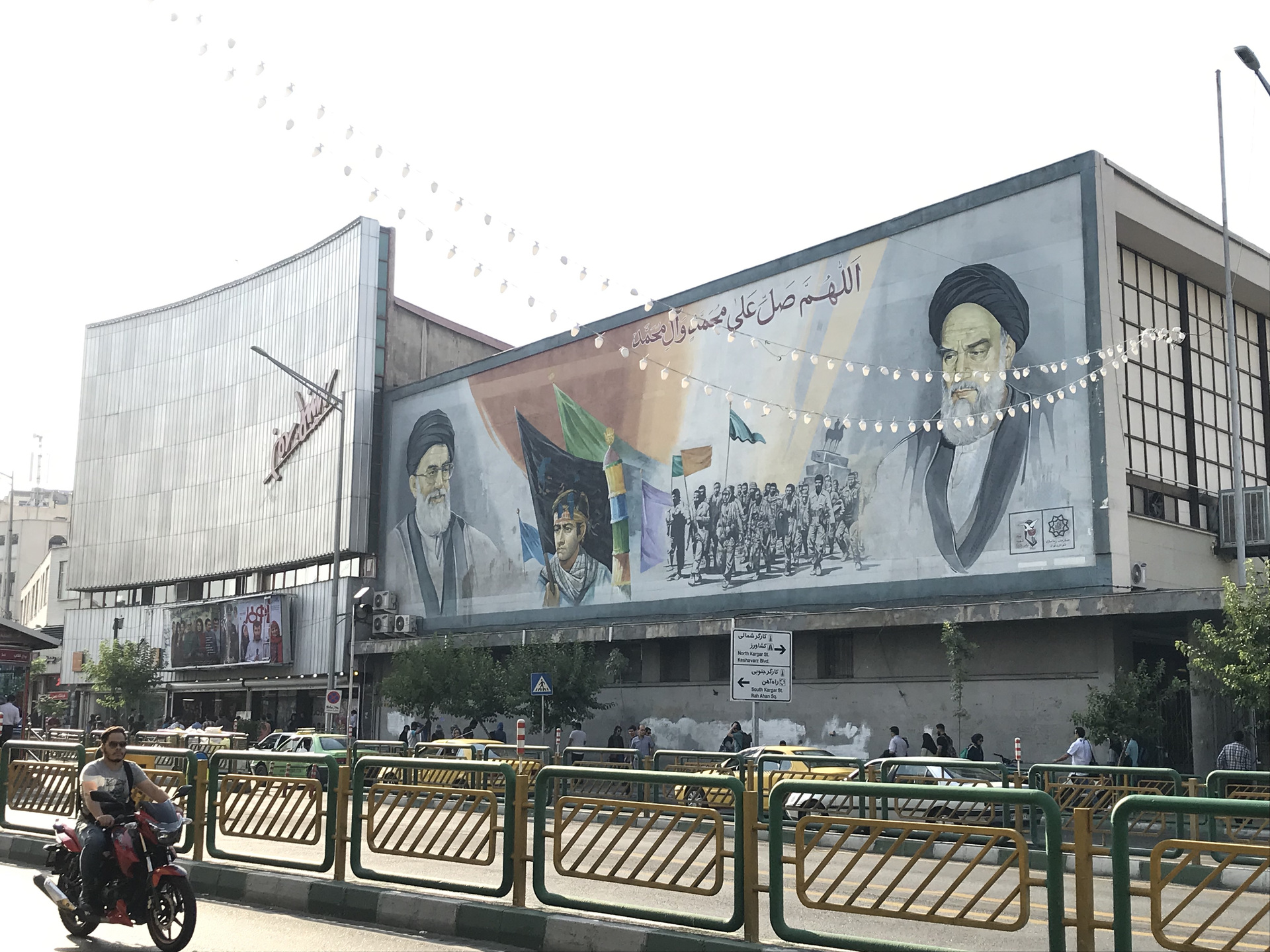
Looking at the images below, which is a usual type of mural to pass by every day in Tehran, reminds me of a line from the Tony award winner play Red by John Logan:
Mark Rothko: There is only one thing I fear in life, my friend... One day the black will swallow the red.
I am genuinely worried that one day the black cloaks will swallow the redness of life, at least my working class survivalist mentality tells me so. I grew up celebrating Christmas with German songs while living in an Islamofascist state. For many years I walked in the school stepping on the American and Israeli flags painted on the floor just before going to the American English class, “now repeat after me students, COCONUT… COCONUT”. I used to pass by Death to America Murals every day, they were aesthetically copied from Soviet Socialist Realism. I loved to watch Spaghetti Western films on national TV with Persian dub, the American cowboy saving the town again. Then it was time to watch SpongeBob in German dub on Super RTL with an illegally installed satellite dish. These experiences cross each other at one point: the Absurd. Only this time it is a hyper version one, a forceful marriage of incompatible world views. I was schooled to be both anti-American and pro-American at the same time. Living by fluctuating between paradoxes became the key feature in defining my identity. Situated in juxtaposition, I was subjected to a schizophrenic duality. In such a context, any self-conscious and self-educated person with the right mind should take a solid position at some point. Such a nonsensical framework made an ever-antagonist person from me; I automatically adopt my identity in opposition to certain things. The act of painting and learning painting opened the path for me to process this hidden mechanism and to shape it on a conscious level.
Living my life and living my body, this existentialist understanding of life, revealed how higher the peak of the mountain and how deeper the valley could get for Sisyphus every time he rolls the stone to the top of the mountain. Being curious and eyeing outward for reason in an utterly mad world had no conclusion but witnessing the disorder. Webster's New Collegiate Dictionary describes ‘absurd’ as a state, where man exists within an irrational and meaningless universe and in which man’s life has no meaning outside of his own existence. In such a world, the very act of searching for meaning pushes the curious man into a more unwanted conflict with his universe. That is the space where my paintings happen – a restless struggle to find reason, order - and above all discipline. A good example of such behaviour would be The Myth of Sisyphus. Sisyphus protests absurdity by embracing his fate, continuing it, refusing to resign. Perhaps I find painting and continuing to paint an act of co-operating with life without actually being able to come to terms with the displacement. Such Absurdist agendas prefer to resist rather than resign, such agendas are genuinely concerned with our sociality in a world stepping into entanglement and confusion with virtuality as if the reality is not complicated enough already. Consequently, my practice organically came to a point to explore painting through a paradoxical trust and mistrust in relation to the aesthetics of Realism and 2D cartoons, and the possible absurdist methods of switching between these two codes. The volume of the absurdity is so immense, it strips off elements of narration or storytelling, to encourage the painting to develop its own identity. The result of following such Absurdist agendas is achieving a vigorous feature: Anti-narrative paintings. This is an attempt to educate rather than dictating and stirring emotions for the sake of populism, opportunism and propaganda.
In a world filled with agents of chaos, painting has been an act of putting things back into order quietly, brush-stroke by brush-stroke, one painting at a time. If curiosity kills the cat, then painting could be about keeping the cat alive to curiously continue to desire, search, find, and observe. A thoughtful and considerate response to the existential threats. A resistance against forgetting. An act of staying visible and present. The act of painting and also keep painting, has been the act of rolling the stone to the top, collapsing and humorously repeating to protest the Absurd.
Ultimately, I see my role similar to Shahrzad who is the muse of the world-famous One Thousand And One Nights myth. Shahrzad tells a fresh story every day to “forestall death, to postpone the day of reckoning that would silence the narrator” (Foucault, 1980) by postponing the punch line to tomorrow. By keep postponing, there will be suspense. And suspense is an art of promising. Suspense says: follow me and there will be a fruitful conclusion just around the corner. Such suspense is an act of staying vigilant and alarmed. What if the conclusion is just another painting, another suspension? As if I am painting one infinite painting, or one painting over and over, to build a sandbox mode to my practice.
-Parham Ghalamdar
Summer 2020