Turner 250 Conference
4–5 December 2025 · Tate Britain, Clore Auditorium, London
The Turner 250 Conference marked the 250th anniversary of J. M. W. Turner’s birth (1775–1851) and asked how his work can be researched, displayed and interpreted today. Organised by the Paul Mellon Centre for Studies in British Art and Tate Britain, the conference brought Turner’s paintings, prints, sketches and bequest into conversation with contemporary curating, audience engagement, ecology, landscape and the limits of a single-artist focus. It coincided with Turner & Constable at Tate Britain.
Necro-Geographies of the Sublime
A Posthuman Reckoning with Turner’s Horizon
Necro-Geographies of the Sublime is Parham Ghalamdar’s multimedia research project, presented at Turner 250. It examines how Turner’s images circulate through mass reproduction and machine vision. The work trains a generative adversarial network (GAN) on roughly 600 low-cost oil reproductions—about 300 each—of The Slave Ship and Rain, Steam and Speed. The model never sees the museum originals; it learns only from their afterlife as factory-made copies, imported into the UK and sold as décor.
As the generator and discriminator compete, storms, ships, trains and horizons emerge from visual noise, flicker, and dissolve. The project treats these unstable images as a way to examine the labour, history and infrastructure carried by an image: from painting and digital reference, through reproduction workshops and global trade, to datasets, platforms and energy-intensive computation.
From Turner to the training set
The Slave Ship (1840) brings abolition, violence and the sea into a turbulent image; Rain, Steam and Speed – The Great Western Railway (1844) frames industrial acceleration and a railway cutting through landscape. The GAN’s source material was not high-resolution museum photography, but inexpensive hand-painted copies made in China and sold in the UK. Those copies turn the canonical image into a commodity shaped by anonymous labour, shipping, décor markets and compressed histories.
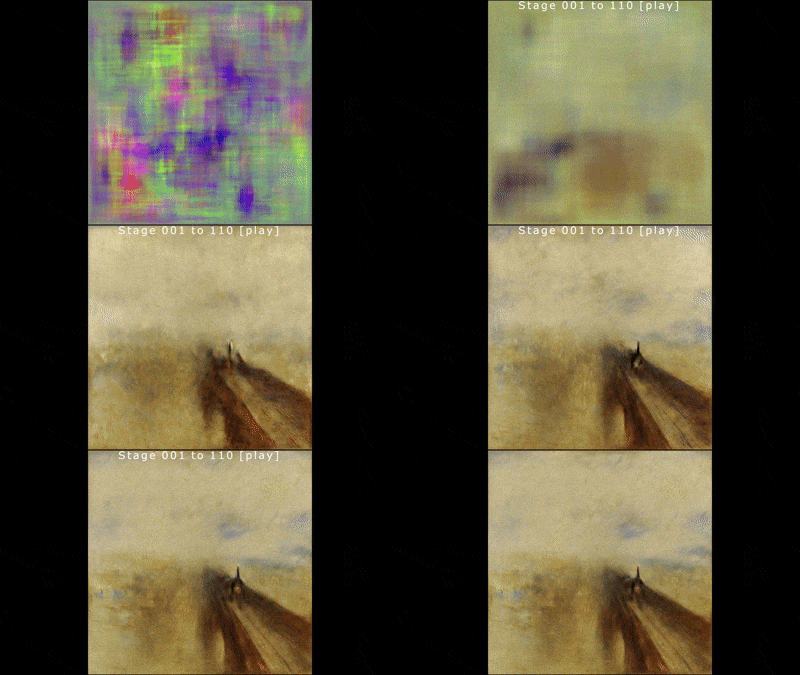
GAN-generated railway study from a training sequence on mass-produced Turner reproductions.
The GAN: imposter and gatekeeper
A GAN pairs two neural networks. The generator (the “imposter”) makes images; the discriminator (the “gatekeeper”) judges whether they resemble the training set. At first, the generator produces noise. Through repeated feedback, patches of colour and familiar compositions begin to stabilise. The aim is not a perfect fake: the work follows the uneasy negotiation through which the machine learns a statistical version of “Turner-ness.”
In the training sequences, a ship, wave, train or bridge may gather from the noise and then disappear. The image behaves less like a fixed painting than a probability cloud. Its glitches expose the limits of the archive and the model’s indifference to the histories encoded in its data.
The square as a machine-made frame
The source paintings and reproductions are rectangular, but the model outputs are square. That 1:1 format reflects the architecture and logistics of machine learning as well as the thumbnail grids of online platforms. The square becomes a new frame: a trace of dataset normalisation, storage, GPU processing and the visual market. It compresses Turner’s compositions into a geometry imposed by contemporary systems.
Ghalamdar uses the generated images as material for prints, paintings and moving-image works, returning machine-made hallucinations to physical and exhibition spaces. Turner’s afterlife is therefore shaped by many agents: the original painter, copyists, networks, the artist, the model and the institutions that display the work.
Climate, computation and extraction
The project connects Turner’s storms, shipwrecks and industrial speed to the energy systems behind machine vision. Data centres, cooling and electricity form part of the image’s material conditions. The work asks viewers to read computational images through the same critical lenses used for industry and empire, attending to historical violence, contemporary labour and ecological cost.
Closing: Turner’s horizon as interface
Turner’s horizon now links global copying economies, cheap décor, machine-learning systems and contemporary curation. The GAN makes that passage visible: its unstable outputs show how “Turner” is reconstructed from noise, error and a historically loaded archive. The project asks how Turner is already being exhibited inside our machines—and what that does to our shared sense of landscape, history and possible futures.
Conference recording
The full presentation recording is embedded below. The video begins at Parham Ghalamdar’s talk.
Image credit: Kate Brock.
